

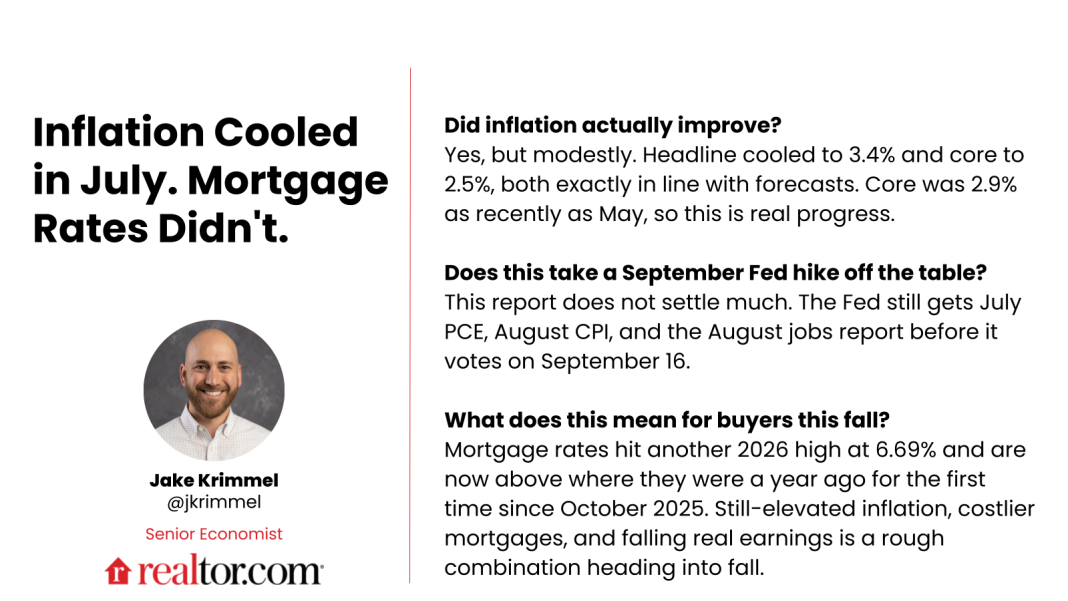

July’s consumer price index landed exactly where forecasters said it would. Headline inflation cooled to 3.4% year over year and core eased to 2.5%, and markets barely reacted. The report was benign, but the inflation outlook is far from settled. Core goods posted their strongest monthly gain of the year, and mortgage rates just hit another 2026 high. Here’s what today’s report means for the Fed, consumers, and the housing market.
July 2026 CPI at a Glance
- Headline CPI: +0.1% MoM Seasonally Adjusted (SA), following June’s -0.4% decline; annual rate eased to 3.4%, down from 3.5% in June
- Core CPI (less food & energy): +0.2% MoM (SA) after a flat June; annual rate eased to 2.5%, down from 2.6%, and down from 2.9% as recently as May
- Gasoline: -2.9% MoM (SA), +24.6% YoY, reflecting an early-July decline that has since reversed
- Core goods: +0.2% MoM (SA), the strongest monthly reading of 2026 after declines in each of the prior two months
- Real earnings: -0.1% in July, as wage growth failed to keep pace with prices
- Market reaction: muted; CME FedWatch odds of a hold at the September 16 meeting ticked up from 55% to 57% on release
July CPI: In line across the board, with two things to watch next month
Wednesday’s July CPI report showed inflation heading in the right direction, but not far enough to move markets or the Fed’s outlook. Headline inflation rose a modest 0.1% in July and cooled to 3.4% annually, while core rose 0.2% after a flat June and eased to 2.5% year over year. All numbers came in exactly in line with predictions from the Cleveland Fed’s nowcast, the WSJ’s survey of economists, and FactSet. Two things to watch for next month’s numbers are gas prices and core goods. July’s headline CPI improvement was helped by an early-month decline in gas prices that has since reversed, a development that will matter more for consumers and politicians than Fed policymakers or financial markets. Core goods meanwhile rose 0.2% in July after falling in each of the prior two months, the strongest monthly reading of the year. This is a small number, but a reminder that the inflation contagion fears we have been tracking since April are still looming; plus, the new tariffs coming online now have yet to hit the official statistics.
This is a small number, but a reminder that the inflation contagion fears we have been tracking since April are still looming.
What it means for the Fed: a benign report that settles nothing
None of this is likely to move an increasingly divided FOMC and prediction markets concur. The odds of a hold at the September meeting ticked up just two percentage points. Most importantly, today’s report is far from the last word on inflation for the Fed. The July PCE prints on August 26, plus August CPI and the August jobs report will also be released before the September 16 FOMC meeting. PCE carries more weight with the committee and looks worse than CPI right now, too. Chair Warsh has been notably quiet on his outlook, so watch for other governors and voters to fill that communication vacuum in the weeks ahead.
What does it all mean for housing, and homebuyers and sellers
For housing, the more immediate question is mortgage rates, which hit another 2026 high last week at 6.69%. Rates are now higher than a year earlier for the first time since October 2025, which means we are not set up for the kind of September sales surge we saw in 2025. For the housing market, it does not matter if PCE and CPI agree. The bottom line is that consumers are still facing elevated inflation, higher mortgage rates, and falling real earnings, which slipped 0.1% in July. Together, this is a rough combination for affordability and housing demand heading into fall, a time when buyers can often get the best deals too.
Talks of a peace deal would be a welcome development for the inflation and mortgage rate outlook in the coming months, though that depends on the Strait of Hormuz reopening as well. The good news is that, despite some bumps along the way, this has not been another cruel summer. Sellers have read the market signals better this year and adjusted pricing accordingly, which has kept sales activity up year over year even as that momentum faded in July.