

Key Takeaways
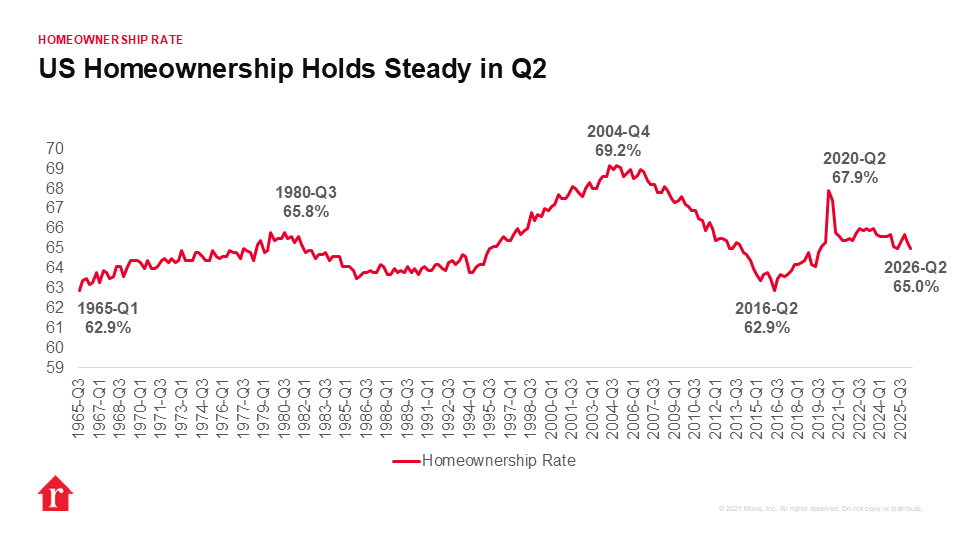
- Homeownership rate holds steady. The U.S. homeownership rate held at 65.0% in Q2 2026, statistically unchanged from both the prior quarter and a year earlier. The rate continues to plateau in a narrow low-to-mid-65% band, with affordability pressures and limited supply showing little sign of easing their grip on the market.
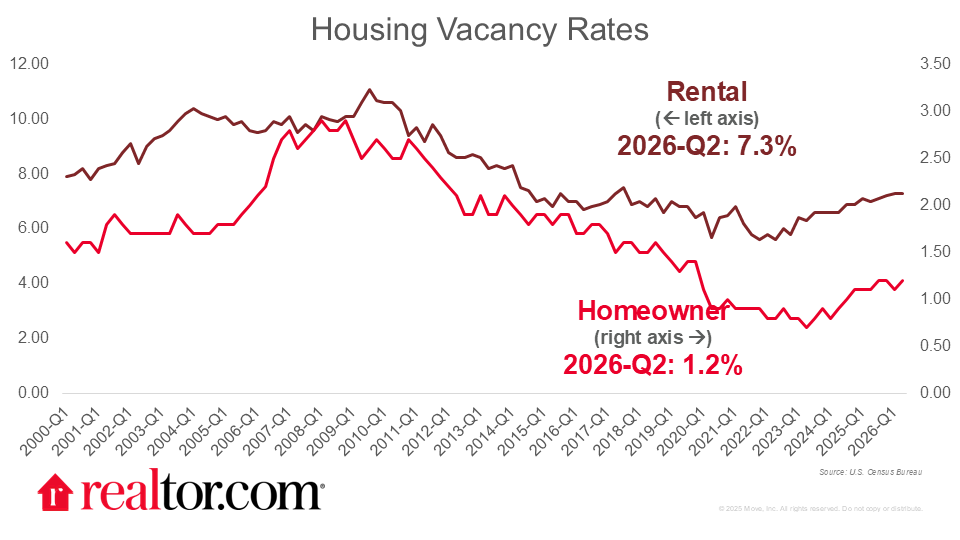
- Vacancy rates are stabilizing after a gradual recovery. The homeowner vacancy rate picked up to 1.2% in Q2, while the rental vacancy rate held at 7.3%, both statistically unchanged from recent quarters. The modest inventory recovery that characterized much of the last year appears to be leveling off rather than accelerating.
- Renting remains a critical pressure valve, though conditions vary by geography. With a national rental vacancy rate of 7.3%, rental markets continue to offer more flexibility for households unable to buy. Conditions vary somewhat by area type: principal cities (8.0%) remain looser than suburbs (6.9%) and non-metro areas (5.8%), though none of the three showed a statistically significant change from a year earlier.
- The South leads in vacancy levels, while the Northeast saw the clearest year-over-year shift. The South posted the highest rental vacancy rate (9.5%) and homeowner vacancy rate (1.5%) of any region, though neither figure was statistically different from a year ago. The Northeast, meanwhile, was the only region where rental vacancy rose year-over-year.
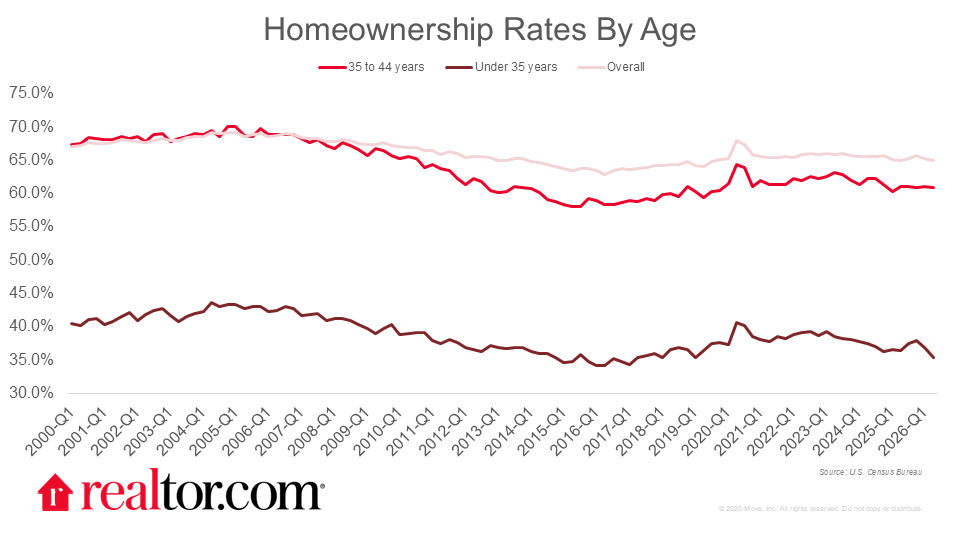
- Younger households are facing growing headwinds. Homeownership among those aged 35 and under fell to 35.2%, down from 36.4% a year earlier — the only age group with a statistically significant year-over-year decline. Other cohorts held relatively steady.
- Racial ownership gaps remain entrenched, but Black homeownership improves. Homeownership rates shifted modestly across groups in Q2. Black householders picked up to 45.4% homeownership, well below the Non-Hispanic White Alone norm, but a considerable improvement both quarter-over-quarter and year-over-year.
What happened this quarter
The U.S. homeownership rate held at 65.0% in the second quarter of 2026, statistically unchanged compared with both the prior quarter and a year earlier. While the rate remains within the narrow low-to-mid-65% range that has characterized the market in recent years, it continues to run well below the pandemic-era highs seen in 2020. Ongoing affordability pressures and a limited supply of reasonably priced homes continue to cap ownership gains.
The homeowner vacancy rate picked up to 1.2% in Q2 2026, slightly higher than a year earlier but not statistically different from the first quarter of 2026 or second quarter of 2025. While homeowner vacancy remains below pre-pandemic norms, the recent stabilization suggests inventory recovery may be leveling off in the near term.
The rental vacancy rate held at 7.3% in the second quarter, flat compared to the prior quarter and statistically unchanged from a year earlier (7.0%). Renting continues to serve as a comparatively accessible alternative for households unable to purchase a home. Vacancy was highest in principal cities (8.0%), followed by the suburbs (6.9%), while non-metro areas posted a lower rate of 5.8%; none of the three area types differed significantly from a year earlier.
Regional differences remain pronounced. The South recorded the highest rental vacancy rate at 9.5%, followed by the Midwest at 6.9%, while the Northeast (5.9%) and West (5.3%) were not statistically different from each other. Of the four regions, only the Northeast saw a statistically significant year-over-year increase in rental vacancy. On the ownership side, the South again led with the highest homeowner vacancy rate at 1.5%, though none of the four regions showed a significant annual change. The Midwest continues to stand out for its high homeownership rate, reaching 69.0% in Q2 2026, though not statistically different from a year earlier, and remains well above the South (66.9%), Northeast (61.6%), and West (60.5%).
Different outcomes by race/ethnicity
Homeownership rates by race and ethnicity were mixed year over year. In the second quarter, the rate for non-Hispanic White householders edged up to 74.5%, while rates declined for Asian, Native Hawaiian, and Pacific Islander householders to 58.6% and for all other racial groups to 54.4%. The rate for Black householders improved roughly 1.4 percentage points quarter-over-quarter and 1.5 points year-over-year to 45.4%, while Hispanic householders saw homeownership hold steady at 48.1%. The gap between the highest and lowest rates remains nearly 30 percentage points, underscoring the persistence of structural barriers to ownership.
Different outcomes by age
By age, the picture was largely stable with one notable exception. Homeownership among those under 35 declined to 35.2%, down 1.6 percentage points quarter-over-quarter and 1.2 points year-over-year, the only age group with a statistically significant annual change. Rates held relatively steady across all other cohorts, suggesting that entry-level buyers are facing ongoing challenges likely due to inventory availability and affordability. Homeownership among households 65 and older remained the highest of any age group at 78.6%.