

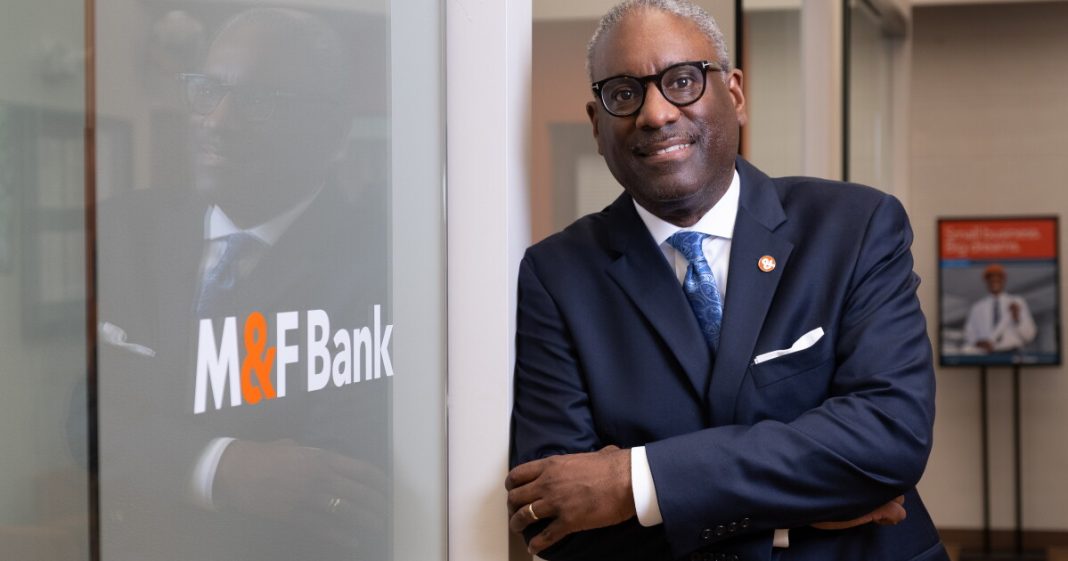

- Key insight: M&F Bank is trying to convince its shareholders to approve a signed merger agreement with Optus Financial, while Triad Business Bank is hoping to scuttle the deal.
- Forward look: M&F shareholders are scheduled to vote on the Optus deal on Nov. 4.
Processing Content
A proposed merger of two Black banks is now up in the air following the emergence of a new suitor for Durham, North Carolina-based M&F Bank.
Triad Business Bank, a six-year-old institution, laid out a detailed argument Tuesday for why its proposal is superior to the one the bank accepted in July.
M&F’s management has dismissed Triad’s arguments, arguing that its shareholders should approve its signed agreement with Optus Financial.
The fight is about not only what’s best for M&F shareholders, but also how best to sustain a Black banking legacy that dates back to 1907.
M&F and Columbia, South Carolina-based Optus are two of less than 20 remaining Black-owned banks in the U.S., and also two of the oldest.
“Together, we will form the largest African American-owned financial institution in the United States and believe that we will be positioned from day one to expand access to capital and economic opportunity across the Carolinas,” James Sills III, M&F’s president and CEO, said in a recent press release.
Greensboro, North Carolina-based Triad is not a Black bank, but its plan calls for preserving M&F’s name, charter and status as a minority depository institution; and for writing into the charter that the bank’s board must be majority African-American.
Triad’s leaders are emphasizing the fact that M&F will cease to exist if it’s sold to Optus.
“North Carolina will have no more African American MDIs,” Jonathan Lee Kelly, a Triad director, told American Banker. “And Triad’s proposal keeps it there, and keeps it an African American MDI.”
Back in July, Optus
Shareholder approval has yet to come, as Triad has been taking steps aimed at convincing M&F to reconsider its decision to sell to Optus. Triad stayed out of the public eye until Oct. 15, when it put out a press release describing the terms of its fourth offer to M&F’s board.
M&F previously scheduled shareholder meetings on Oct. 7 and Oct. 20, but both sessions were adjourned without a vote in an effort to give shareholders time to consider Triad’s proposal. M&F now has a special shareholders’ meeting scheduled for Nov. 4.
M&F’s largest shareholder is Salt Lake City-based Exploration Capital Fund, led by investor Stephen Gustin, with 10.2% of the outstanding common stock, according to the bank’s most recent proxy statement.
On Monday, M&F
Dueling narratives
Triad is not giving up. On Tuesday, it released
Part of that argument is that M&F’s shareholders will fare better if they take Triad’s offer, even though it would leave them with a bit less than half of the shares of the combined company.
Triad projects that the combined bank’s tangible book value per share will rise from $29.87 at the deal’s closing to between $44.52 and $49.50 five years later.
Triad has criticized M&F for not lending more. It argues that by joining forces, the two banks will be able to drive faster growth, including by lending more in the vicinity of numerous historically Black colleges and universities.
“The combined footprint runs the length of I-40 and I-85 from Charlotte to Raleigh,” Triad said in its presentation. “Major employers — SAS, Cisco, IBM, Pfizer, Honeywell, Guilford County Schools — sit inside it. So do six HBCU campuses with rezoned land, vendor ecosystems and housing demand that no bank in the corridor has yet organized itself to serve.”
Read more:
Sills, the M&F president and CEO, declined to comment for this article. Optus representatives did not respond to requests for comment.
But in its latest public filing, M&F suggested that it believes Triad is making overly rosy projections.
“Triad’s figures depend on a future Nasdaq listing it only ‘targets’ based on its own theoretical projections. In the Board’s view, Triad’s business record does not support those projections,” M&F stated. “Triad’s share price has declined by more than 30% over the past six years, and its results have been substandard and predominantly unprofitable.”
Triad is making similarly derogatory statements about M&F’s financial track record, implying that M&F squandered the opportunity provided by an $80 million injection from the Treasury Department’s Emergency Capital Investment Program in 2022.
Startup banks typically take a number of years to become profitable. Triad, which was founded in 2020, first turned a profit in 2025. The $536 million-asset bank reported net income of $1.4 million last year and $482,000 through the first six months of this year.
M&F, which has $476 million of assets, reported net income ranging from $1.2 million to $5 million in each of the years between 2020 and 2025.